

who am I? Latest research shows that mind and body are inseparable
Mind and body connection
Why is our body so important? Research shows that subtle shifts in our physiological bodily states, even when not perceived consciously, may contribute to our emotions and the sense of self.
“When we hear the word ‘heart’ in ancient yoga texts and the Upanishads, it does not refer to the physical organ pumping away inside our chests. Instead, it refers to the space within the centre of the chest, the space where emotions seem to resonate and the centre of our identities seem to reside in our bodies. That’s where we point when we say “I.” — AG Mohan and Ganesh Mohan
According to Western scientific tradition this does not make sense. But, as we keep learning and pushing the boundaries of physiology and neuroscience, we see the meaning of these ancient texts differently. A recent article in the prestigious journal “Trends in Cognitive Sciences” shows that our cognition is formed by the interplay between the brain and the bodily senses.
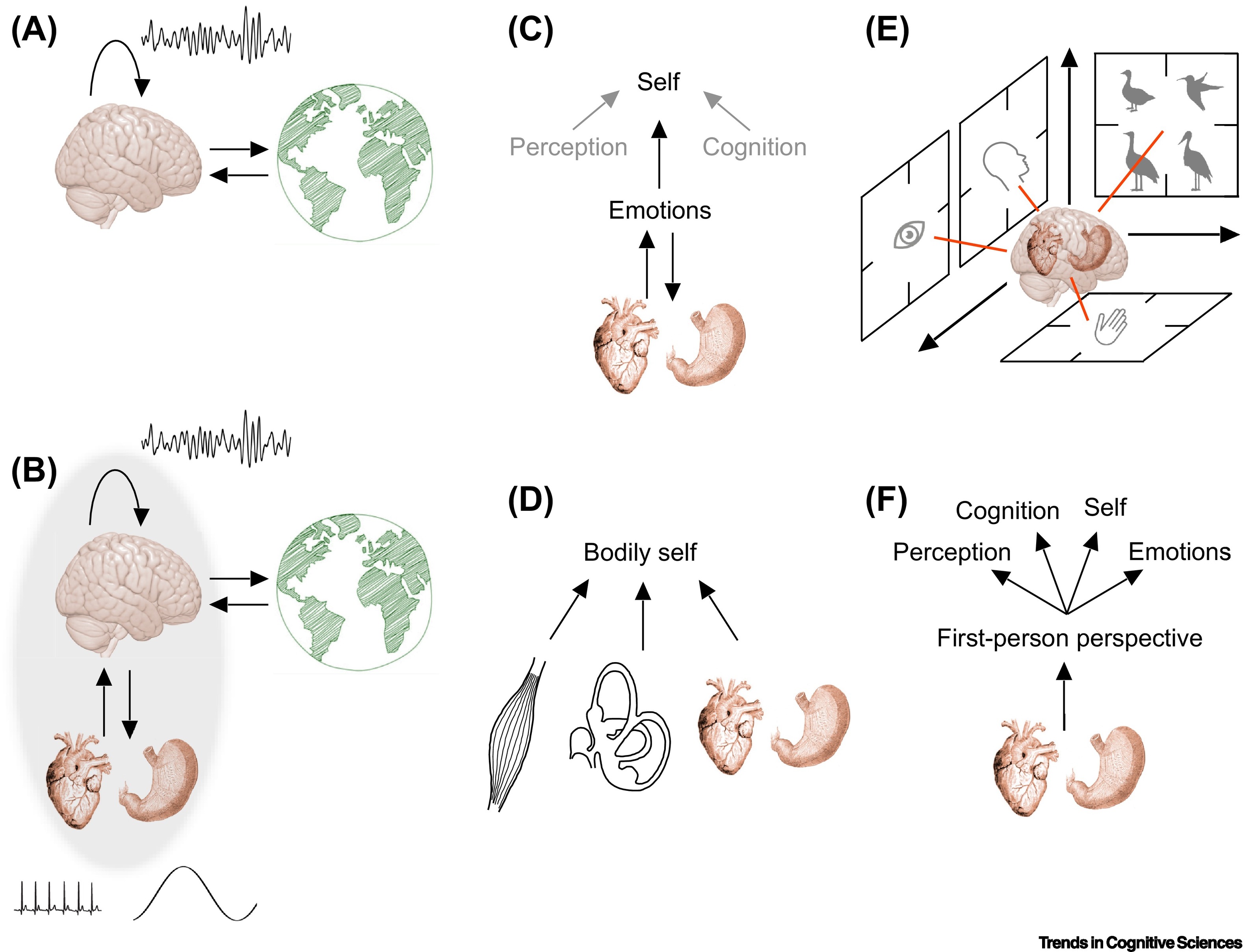
Brain–Viscera Interactions. (A) Classical paradigm of brain–environment interactions. (B) Extended paradigm that includes brain–viscera interactions, and more specifically the heart and gastrointestinal tract, which both intrinsically generate their own electrical activity and potentially contribute to brain dynamics by continuously and automatically stimulating the brain. (C) According to some theories, changes in visceral states could contribute to emotions and ultimately the self. (D) Another view holds that the bodily self arises from the multisensory integration of proprioceptive, vestibular, and also visceral ascending signals. (E) A third proposal is that neural monitoring of ascending visceral inputs is used to coordinate the different frames of reference in which sensory, motor, and cognitive information is organized, to (F) generate the first-person perspective inherent to conscious perception, cognition, self, and emotions. FULL ARTICLE HERE
Our emotional experiences are linked to changes in our bodily states. For example, the experience of fear results from an integration of an external input (something scary) and an internal physiological state of the body (such as shallow breathing, sweating, increased heartbeat). This integration happens in the brain region called the insula. Subtle shifts in physiological states, even when not perceived consciously, may directly contribute to emotional feelings.
Signals from our body also form the sense of self. Our sense of self is grounded in our sensory experiences: sight, hearing, smell, touch, proprioception (the sense of muscles and tendons), vestibular sense (the sense of balance and spatial orientation) and interoception (the sense of heartbeat, guts, temperature and other body signals). External signals shift and change constantly, and even a slight head move may change the way we see things. Internal bodily signals, even if unnoticed, are more constant. Researchers suggest that continuous neural inputs from the gut and heart to the brain generate the unique bodily-centred viewpoint: the sense of "me", “my body”, “my mental life”. This sense of “mine-ness” is central for our conscious experience.
This latest research changes our understanding of the human mind, consciousness and wellbeing, and shows a paradigm shift in Western science — we see now that the mind and body form a single system and are inseparable. Our heart can really, and not just metaphorically, carry emotions and the sense of self.
I trust that this new understanding will pave the way for more holistic approaches in healthcare — such as yoga and yoga therapy.
Yoga: embodied practice of connection
“In that heart centre, the mind is conceptualised as a lotus flower, closed and upside down. In anjali mudra, we bring the fingers of our two hands together, the base of the palms touching, with the knuckles apart from each other. The palms are not flat against each other but are shaped like the bud of a lotus flower — ready to blossom with the touch of the sunray just as our hearts are ready to open with the teachings and practice.” — AG Mohan and Ganesh Mohan
HI, I AM IRINA

I am a yoga teacher and a scientist. In this blog I write about the most recent scientific research about yoga/meditation/mindfulness. Please leave comments and share your thoughts!
Feel free to read Irina's previous blogs are here.
You like what you read?
Sign-up for the newsletter and receive updates and more!
compassion based yoga for psychotic vulnerability
This article highlights a yoga therapy approach for working with people with psychotic vulnerability and reflects the experience of a yoga therapist who is also a medical professional. It is not intended to serve as a “how to” article for yoga teachers. If you are interested in attending a training with me, Anneke or learning more about my approach, please join one of the Integrative Yoga Therapy trainings or Coaching & Yoga Therapy sessions.
It’s Monday morning. I place two mats and two pillows on the ground as Chris walks into the room, mumbling. He seems a bit absent. Chris is a 27-year-old man who has been diagnosed with schizophrenia. Chris likes basketball and music. He was a rapper before his diagnosis. When he was 17 years old, he experienced his first psychotic episode after a stressful time in his life. His mother (who Chris had lived with) died of cancer when he was 16. At 17, he dropped out of college and started to experiment with marijuana. It's always difficult to say what caused what exactly. Life experiences, the use of drugs, and a possible vulnerability to psychosis that the drugs may provoke may be triggers for his psychotic episodes. He now takes daily antipsychotic medication, which makes him feel tired and has caused him to gain weight, which frustrates him.
I see Chris weekly as part of my work as a registered nurse and yoga therapist in a mental healthcare institute. When I began working with Chris, he didn’t really believe yoga was going to help him, but he wanted to give it a try anyway.
Schizophrenia Awareness Week
Schizophrenia Awareness Week (SAW) has been held in May every year since 1986. The Week aims to reduce stigma towards people affected by schizophrenia, bust myths about schizophrenia, and promote help-seeking by people affected by schizophrenia and their carers. The awareness week for schizophrenia coincides with the lead up to World Schizophrenia Awareness Day on May 24.
Schizophrenia and Psychosis
Schizophrenia is one of a number of schizo diagnoses. Its symptoms can affect quality of life quite a lot, as can the social stigma attached to the condition.
Symptoms of schizophrenia typically emerge in adolescence and early adulthood. There are both, what we call “negative” and “positive” symptoms. Negative symptoms refer to those that consist of a decrease or absence of function, including flat expressions or little emotion, poverty of speech, inability to experience pleasure, lack of desire to form relationships, and lack of motivation. Positive symptoms are those that consist of increased or distorted function, including symptoms associated with psychosis such as hallucinations.
The term “positive symptoms” can be confusing because the word “positive” gives the impression that it concerns symptoms that are pleasant. This is not the case. In case of a psychosis you can suffer from positive symptoms. The word “positive” refers to the fact that these symptoms are phenomena that, in addition to normal functioning, have been added extra. These are experiences that were not there at first, but were added to it.
Psychosis is one of the main symptoms of schizophrenia. Typically, in psychoses, people experience delusions (for example, extreme suspicion) and hallucinations (for example, perceiving voices beyond control or seeing things that others don’t observe). However, a psychosis is a syndrome consisting of different types of symptoms, and the mix of symptoms looks different in everyone. For example, one person may experience, in particular, feelings of distrust while another hears (perhaps violent) voices. Another may experience mood swings that sometimes cause depression and at other times cause a manic state. Still others experience a lack of motivation to perform daily tasks, a lack of attention and concentration, and others cognitive problems.
Consider this scenario: To be able to learn how to react in a flexible way to the world around us, we must constantly give meaning to what we experience. For example, we may wonder, Are the other passengers on the bus laughing at me? In order to learn how to respond skillfully to such questions, it's sometimes very healthy to be a little suspicious.
But extreme suspicion (delusions) make proper functioning difficult. Then, for example, we think, Everyone in the bus or on the street is looking at me, laughing at me. We speak of a “full” psychosis when psychotic experiences control a person’s life so much that they do not function well on a daily basis.

In modern mental healthcare, we start to look at these experiences on a spectrum. Every human being can have some experiences to one degree or another: Perhaps hearing voices on one end of the spectrum to possibly being bugged by a very strong inner critic on the other end. Some people have intense spiritual experiences, for example, that can lead to a particular state of consciousness and growth. In other cases, psychosis might be a way to deal with traumatic events for a person who is trying to cope and survive. These experiences should, of course, be taken seriously, and a person should receive optimal care, (professional) guidance, and support as needed.
Treatment for schizophrenia seeks to give a person back their ability to function. Although current treatments provide control of, rather than a cure for, schizophrenia, long-term hospitalization is generally not required, and one’s prognosis is much better than traditionally assumed. The general treatment for schizophrenia is medication, which often must be taken for a very long time.
Unfortunately, the medication often comes with numerous side effects and it’s hard to find the optimal balance of meds. Common side effects include stiffness and shakiness in the body, restlessness, weight gain, and movements of the jaw, lips, and tongue. Fatigue and constipation are common too.
The healing process is different for every individual, but full recovery from psychosis and schizophrenia is possible.
Where Yoga Comes In
As a supplement to standard treatment, yoga can give a person living with schizophrenia tools to cope with the symptoms of psychotic vulnerability and the side effects that they may experience from treatment. The tools that yoga provides, applied in daily life, may assist a person in connecting to their body and finding their own inner resources (for example, through breathing) that help them to be more confident and trust their inner wisdom in the often challenging journey toward recovery. To this end, yoga may be a great addition to current treatments.
It’s important to highlight the need to identify, assess, and address trauma in this population, which for too long has been overlooked and under-treated. It is therefore especially important that the yoga that is offered to people living with schizophrenia be trauma-sensitive.
Compassion-Based Yoga Approach
In my yoga therapy work with people with psychotic vulnerability, I use a method of my own design—Compassion-Based Hatha Yoga. In this approach, I prioritize two elements: providing a sense of safety, and normalizing a person’s psychotic vulnerability in spite of social stigma. For each person I work with, I seek to balance these two priorities as I customize a yoga practice that is appropriate for that individual.
Creating a sense of safety means ensuring that a person feels safe both internally (in the body) and externally (outside of the body—in the room, for example). That sense of safeness allows me to work with my students on being aware of and connecting to their bodies—and to all their experiences—as a first step in making positive changes such as cultivating compassion, patience, and acceptance toward oneself. Yoga practice offers a lot of opportunity to practice self-compassion of this kind. Then, when awareness becomes a little easier and trust is gained, we might move on to observing the body and all experiences, thoughts, and behavior while we practice, if this feels safe enough. I constantly evaluate a person’s sense of safety and go back to a “safer” place, if needed.
Normalizing the disorder means contextualizing the physical symptoms on a broad spectrum (as discussed above) and acknowledging them as coping mechanisms so as to destigmatize mental health conditions.
In addition to realizing these two priorities, I also try to ensure that every yoga session I teach for this community is trauma-sensitive since, as noted, trauma is so often an underlying cause of psychosis. The teacher’s choice of words (for example, not using words such as “patient” and “psychosis”) is very important for making a class trauma-sensitive and also for destigmatizing the condition.
Not only do I use the Compassion-Based Hatha Yoga approach in my own one-on-one and group sessions, I also train other healthcare providers in it and speak about it at conferences all over the globe.
yoga therapy, mental health & mother earth?
terrapy | integrative yoga therapy
Results
Through our sessions, Chris has been able to observe himself and his experiences (symptoms) to increase his awareness of them. He has learned to use the tools of yoga (asana, mantra, breathwork, and gentle meditation) to foster that awareness.
He has also learned how to cultivate more compassion toward himself and his experiences. In our sessions, we don’t try to deny his symptoms or experiences; rather, we are learning how to understand the messages behind them.
Yoga also helps Chris to manage his experiences. It seems that accepting and managing the experiences, instead of trying to push them away, decreases the intensity of them: He feels a bit lighter after a session, as if his experiences have “dissolved” a little bit. The voices become less loud and hostile. Using what he learns in class in his life, and seeing the positive results of his efforts, has been very empowering. He’s been motivated to change his eating habits, which has resulted in losing some weight, which was something he really wanted to do, and it has made him feel more confident.
The practices have strengthened his cognitive functions as well. As I supported Chris in gradually beginning to practice small exercises from the session even outside of class, his growing awareness and the techniques he’d learned helped him to make small changes in the patterns of his daily life, creating new, healthier samskaras (habit patterns) that include hope, optimism, and self-acceptance. He has learned to focus and concentrate better and how to manage his stress levels on his own.
This particular use of yoga (i.e., in the complementary treatment of schizophrenia) still remains in its very early phase, but the case reports and research results are promising.
I teach yoga for psychosis with an attitude of great optimism and hope, as optimism and hope are the most important predictors for a good recovery from schizophrenia. There hasn’t been very much research done on the therapeutic effects of yoga in the complementary treatment of conditions like schizophrenia, but that is changing. In the last few years, researchers have increasingly recognized yoga’s ability to support people with conditions like this one. This particular use of yoga (i.e., in the complementary treatment of schizophrenia) still remains in its very early phase, but the case reports and research results are promising.
My personal evidence is seeing Chris motivated to join almost every class and progressing noticeably every time. That is the reward of working as a yoga therapist in mental healthcare. I am wholeheartedly committed to continuing to do this work and to teaching more and more teachers and therapists in both yoga and healthcare communities about Compassion-Based Hatha Yoga, which is useful for everyone, but especially for this population who stands to benefit so much from it.
When working with this population, I strongly advise those that I train and educate to keep an open mind, listen well, do not make any assumptions, and optimize your attitude of hope and optimism. If a client feels seen by you, this might have a bigger positive effect than you can imagine.
CONTINUE READING ->>>
HI, I AM Anneke

You are your own therapist, and I am here to support you!
As a sustainable life philosophy for health and wellbeing, yoga and meditation offers great tools.
I hope to inspire you improving your habits, find a state of optimal balance and live your happiest and healthiest life!
Read Anneke's previous blogs here.
BOOK YOUR YOGA THERAPY OR COACHING SESSIONS HERE
Online or in-person
This article was first published at Yoga International.
Let's talk. Now, I'd love to hear from you! Please use your voice and write your comment or QUESTION about yoga or yogatherapy below.
You like what you read?
Sign-up for the newsletter and receive updates and more!
how can we cultivate human connection in yoga?
We often see connecting to others as a psychological or mental act. But connection happens at the body level. To connect to another person, we tune our breath, voice, and posture. This tuning is controlled by the endocrine system and the autonomic nervous system and happens outside of our conscious awareness.
Sue Carter is an internationally recognized expert in the biochemistry of social behavior. Her husband, Stephen Porges, is the founding director of the Traumatic Stress Research Consortium and the founder of the Polyvagal Theory. Both are distinguished professors in neuroscience. Sue and Stephen gave keynote lectures at The Yoga Therapy Conference in Amsterdam last week. They talked about love, connection, emotional safety and trauma.
Here is what I learned, in a nutshell: i) we all long for connection, ii) connection and love can heal as medicine iii) as yoga teachers and yoga therapists, we can bring more connection into the world. Perhaps it’s the best thing we can do.
CONNECTION IN YOGA
This list is an integration of the knowledge of physiology and biochemistry of human connection, insights from other Conference speakers, and my own experience, based on the Svastha yoga vision.
- Start with an intention. Invite the qualities of connectedness and acceptance.
- Create a safe environment. Think about the space where you teach (light, colours, scent), your appearance and tone of voice.
- Integrate chanting in the class. Chanting brings us to the state of safety and calmness. By chanting mantras together with students we develop a shared intention. Just chanting Om or making a humming sound together helps us feel the presence of others.
- Teach breath awareness. Slow breathing with emphasis on exhalation is the most powerful and accessible tool for shifting physiological states.
- Integrate elements of gentle self-massage.
- Encourage students to listen to themselves in their practice. Body awareness is the key to regulating physiological states.
- Ask students to tell what they feel.
- Listen with open attention and without judgement.
- Foster social bonding, make space for tea and chats after the practice.
- Practice all these for yourself.
humans need connection, attachment and love
Humans have evolved to live in communities. “Connectedness is a biological imperative. It provides the neurobiological mechanism to link social behavior and both mental and physical health, ” says Stephen.
People without social connection are at risk of various forms of illness. Studies of the elderly show that social support is one of the most important factors in after-stroke recovery. In psychotherapy, common factors such as empathy, warmth, and the relationship between the client and therapist correlate more highly with client outcome than specialized treatment interventions.
I could not help but think about the famous Harvard Study of Adult Development, that tracked a large cohort of people born in the 1930s. Researchers collected data on their physical and mental health for over 80 years. The results showed that close relationships are what keep people happy throughout their lives. Those ties are better predictors of long and happy lives than social class, money, career, or genes. To flourish, humans need connection, attachment and love.
Love is medicine
Most of what we know about the biology of love comes from research on animals. The neuropeptide called oxytocin facilitates birth, lactation and early nurture in all mammals, including humans. It drives parental behavior, and makes mothers and fathers adore their babies.
Oxytocin is critical for connecting and bonding in both sexes, and in all ages. Increased levels of oxytocin are associated with the feeling of trust, empathy and cooperation. Sue says: “Oxytocin facilitates a sense of safety. It promotes our capacity to be close to and sensitive to others.”
Love is a complex neurobiological process. Receptors to oxytocin are found in the brain areas responsible for emotions. By acting inside the brain, oxytocin directly reduces fear and anxiety. On top of that, oxytocin works on the autonomic neural system: it downregulates the sympathetic nervous system while supporting the protective and restorative functions of the vagus.
Oxytocin is more than a “love hormone”. It appears to be one of the key regulatory molecules in the body. While it is synthesised in the brain, it has a capacity to move throughout the body. Different body systems, including the autonomic nervous system, immune system, bones and gut, are sensitive to oxytocin. It regulates basic physiological functions such as the balance of electrolytes, gastric motility and eating behavior. Oxytocin can protect the body tissues from stress and inflammation, enabling the body to heal and restore.
Love is medicine.
Yoga: embodied practice of connection
Stephen Porges has coined the term “neuroception” – the unconscious ability to quickly adapt bodily responses to danger or safety. When we detect danger, we shrink and tense, our breathing becomes shallow, our heart beats faster, and our voice pitch becomes higher. On the other hand, when we feel safe, we release muscle tension, soften the breath and the voice, and tune in for connecting with others. All these changes reflect a shift in the state of the autonomic neural system.
While these reactions are outside of our awareness, we can consciously use posture, breath, and voice to get to a state of safety. That’s what we do in yoga. Yoga practice gives us a unique way to reset our physiology to experience safety. Stephen says: “Yoga is a ‘family’ of neural exercises regulating physiological state”.
HI, I AM IRINA
I am a yoga teacher and a scientist. In this blog I write about the most recent scientific research about yoga/meditation/mindfulness. Please leave comments and share your thoughts!
Feel free to read Irina's previous blogs are here.
Feel free to share your story, question or feedback below this post, we love to hear your voice too!
You like what you read?
Sign-up for the newsletter and receive updates and more!
true consent is justice in action
This blog was written by Theo Wildcroft and was originally published on her website. We post it here with the author's permission, because we love it.
What worries me most about yoga as an adjunct therapy right now, is standardisation, and the rise of the expert voice. I’m hearing about more and more trainings in trauma-sensitive yoga in particular, that are giving teachers alarming advice.
I meet teachers who tell me that after a few days of training, they know what I need as a survivor of trauma.
They tell me that survivors will never close their eyes, but that you, the teacher, should close yours and never open them during teaching.
They tell me that survivors should never be touched.
They should never do yoga nidra.
They should be told how to breathe – to impose a specific, counted ratio of inhalation to exhalation.
I checked with others to be sure, and most of the survivors I asked would never return to classes that followed one or more of these rules. Now I know that working with a highly vulnerable population with active PTSD is different from making a general class a little safer. But given that the only common symptom of trauma is the loss of personal agency, yoga teaching that is not based on co-constructed content can never be appropriate.
In short, I’m hearing more and more stories of survivors having adverse reactions in yoga, and being told ‘but this expert told me it was safe’. And I want to know why those trainers aren’t telling teachers to ask their students about what does and doesn’t work for them.
My only formal treatment was three years of talking therapy in my early 20s. This did nothing to regulate my nervous system. I found my way by instinct into dance and martial arts, contact improvisation and yoga. And although I wouldn’t recommend it, I also found MDMA and psilocybin, and I credit all of these as part of my personal recovery.
So now that we are seeing research that explores the use of movement and mindfulness, psilocybin, and MDMA in the treatment of trauma, I need to remind you that survivors have been using these techniques for effective recovery for much longer than therapists and yoga teachers have been reading Bessel van der Kolk.
To heal all we need:
agency over our own choices to create…
individualised strategies to gather…
personalised resources for…
self-regulating our nervous systems with…
time and space to integrate them.
At the heart and centre of what we do, we need to start teaching yoga as a therapy of empowerment based on the principles above. We need to flatten our hierarchies when we come together in practice, celebrate differences, and ask what our students need from us, and what they already know how to do. It’s about a quality of relationship far more than the tools we can offer. Yoga is a toolkit for liberation, that has too often been appropriated both for oppression, and for well-meaning disempowerment.
My trauma, my survival, my healing, is not a resource for you to extract. It is inseparable from the relationships that shaped me, and continue to hold me.
Just as yoga teachers are turning to a post-lineage model, not to replace traditional teachings, but to build a safer context around them, perhaps we need to reclaim yoga therapy from medicalised, standardised spaces. We need to connect in shared authenticity, and humility, meeting in the practice as equals, not just experts and clients.
It will be an imperfect, flawed experience. We will continue, in our enthusiasm, confusion and fatigue to make assumptions about who we can hug, and who wants us to pat them on the shoulder after class.
Worst of all, there may be people waiting to take advantage of our vulnerability to abusive ends. When this happens, may our policies and practices, our culture and our community, be there to help us heal and learn from these mistakes. And may none of us be too badly scarred in the process.
Above all, consent is not a shield we use to protect people, or a tick box to be checked before the work can begin. Instead it is the key to the many ways in which we can heal and evolve together
True consent is justice in action
You like what you read?
Sign-up for the newsletter and receive updates and more!
HI, I AM Theo

I'm a yoga teacher based in north Wiltshire working for a more sustainable relationship between our many selves, the communities that hold us, and the world that nourishes us. I'm a lover of vulnerable people, of wild things and wild places, of all our ancestors, and of the simple miracle of life itself. I am particularly fond of rhythmic movement and gentle devotion. I’m also a doctoral researcher investigating the democratization of physical practice, how it evolves, and why it matters. I blog and write articles on this, on social justice, on hope, and on untold stories.
survey: What is yoga therapy really?
This blog was first posted by Irina Sheftel on May 1st, 2019 and was updated in 2022.
In April 2019, Network Yoga Therapy was setting up an online survey, inviting yoga therapists from around the world to to get to know them a little better, and they answered questions about their work. Below we share the outcomes from this survey and learn what the yoga therapists answered to the question: 'What is yoga therapy?' If you like to dive in a bit deeper, please check out this article on yoga therapy too.
Why do we of network yoga therapy care?
We love our community and we really like to get to know them better. We are curious, we ask questions. Yoga therapy is a growing, maturing field and we realize that together as a community we can answer the question 'what is yoga therapy?' in the best way. Further more, we would love to see yoga therapy to become a profession, with educational and quality standards in place. We also want yoga therapy to be recognized by institutions and professionals in other fields, such as medicine, mental health, physical therapy, social welfare, and education. To get there, we need to know where we are now. Here we present the first part of the survey results.
YOGA THERAPISTS: WHO ARE THEY?
79 people from 24 countries completed the full survey. Yoga therapy seems to be a women’s world: 91% of respondents were women, and 42% indicated that they mainly work with female clients.

Half of the respondents are certified yoga therapists, and among those people who are not certified, most are currently in the process of certification with the International Association of Yoga Therapists (IAYT) or another recognized institution. The majority finds the certification important. Only one person replied that she doesn't need the official certification because she “has enough background and experience to certify for this”.
other professions that combine with yoga therapy
More than half of the respondents (69%) consider and advertise themselves as yoga therapists. Most of them have more than 10 years of personal yoga practice: 22 years on average. 83% combine yoga therapy with another profession, most commonly working as yoga teachers or healthcare professionals.
- yoga teaching/ bodywork
- healthcare professions
- academic work
- coaching
- corporate functions
- education
- writing
- art

conditions yoga therapists work with
Most of the yoga therapists do not have a specialization, but they work broadly with a range of conditions (from highest to lowest number):
- Stress and anxiety
- General mental health
- Back pain
- Depression
- Musculoskeletal conditions
- Women's health
- Physical fitness
- Trauma

We kind of suspected it, but most of the yoga therapy clients are middle-aged, middle-class women.

Professional standards
We also asked people what they consider the main difference between a yoga teacher and a yoga therapist. Education, experience, training and personalized approach were mentioned the most. Our respondents also indicated that yoga therapy should be evidence-based and results-oriented. A yoga therapist should have enough medical knowledge to assess the client and know how to work with diagnosed conditions using yoga tools. At the same time a yoga therapist “applies a holistic approach, reaching out and incorporating Ayurveda and yoga philosophy”.
yoga therapy, mental health & mother earth?
terrapy | integrative yoga therapy
THE BIGGEST CHALLENGE
While these differences between a yoga teacher and a yoga therapist seem to be very clear for our respondents and us, the rest of the world does not seem to get it yet. Answering the question: “What challenges do you face as a yoga therapist?”, most people say that the public and medical professionals do not see the difference.
In most countries, yoga therapy is still not recognised as a legitimate treatment. Less than 5% of the respondents indicated that the yoga therapy treatment for their clients is covered by insurance. It seems that insurance covers the treatment only if the yoga therapist is also a licensed healthcare professional (physiotherapist, psychiatrist).

The biggest myth
We also asked what the biggest myth of yoga therapy is. Reassuringly, yoga therapists do not see yoga as a cure-all approach. Almost half of our respondents replied that the biggest myth is that all yoga is a cure to anything.
“[The biggest myth is]... that all yoga is therapeutic - it's not. It has the potential to be, but only if the practice is a good match for the person. That yoga can solve or cure everything - it cannot, although the practice and philosophy can both be immensely beneficial. That yoga alone is enough - it's not. Make use of everything that is good and appropriate to a person's condition. There is good to be found in all the healthcare modalities and methods." | Lisa Kaley Isley, UK, psychologist and yoga therapist
We are very grateful to everyone who took the survey. There is so much valuable information there, and we will present more results in future blogs. At the Yoga Therapy Conference in Amsterdam one week from now, we will talk about the status of yoga therapy in Europe, the USA and eastern countries. It seems that, despite differences in healthcare policies around the world, the problems we are facing are similar.
“We need to continue to work together across the globe.” John Kepner, USA, IAYT president
You like what you read?
Sign-up for the newsletter and receive updates and more!