
Mind and body connection
Why is our body so important? Research shows that subtle shifts in our physiological bodily states, even when not perceived consciously, may contribute to our emotions and the sense of self.
“When we hear the word ‘heart’ in ancient yoga texts and the Upanishads, it does not refer to the physical organ pumping away inside our chests. Instead, it refers to the space within the centre of the chest, the space where emotions seem to resonate and the centre of our identities seem to reside in our bodies. That’s where we point when we say “I.” — AG Mohan and Ganesh Mohan
According to Western scientific tradition this does not make sense. But, as we keep learning and pushing the boundaries of physiology and neuroscience, we see the meaning of these ancient texts differently. A recent article in the prestigious journal “Trends in Cognitive Sciences” shows that our cognition is formed by the interplay between the brain and the bodily senses.
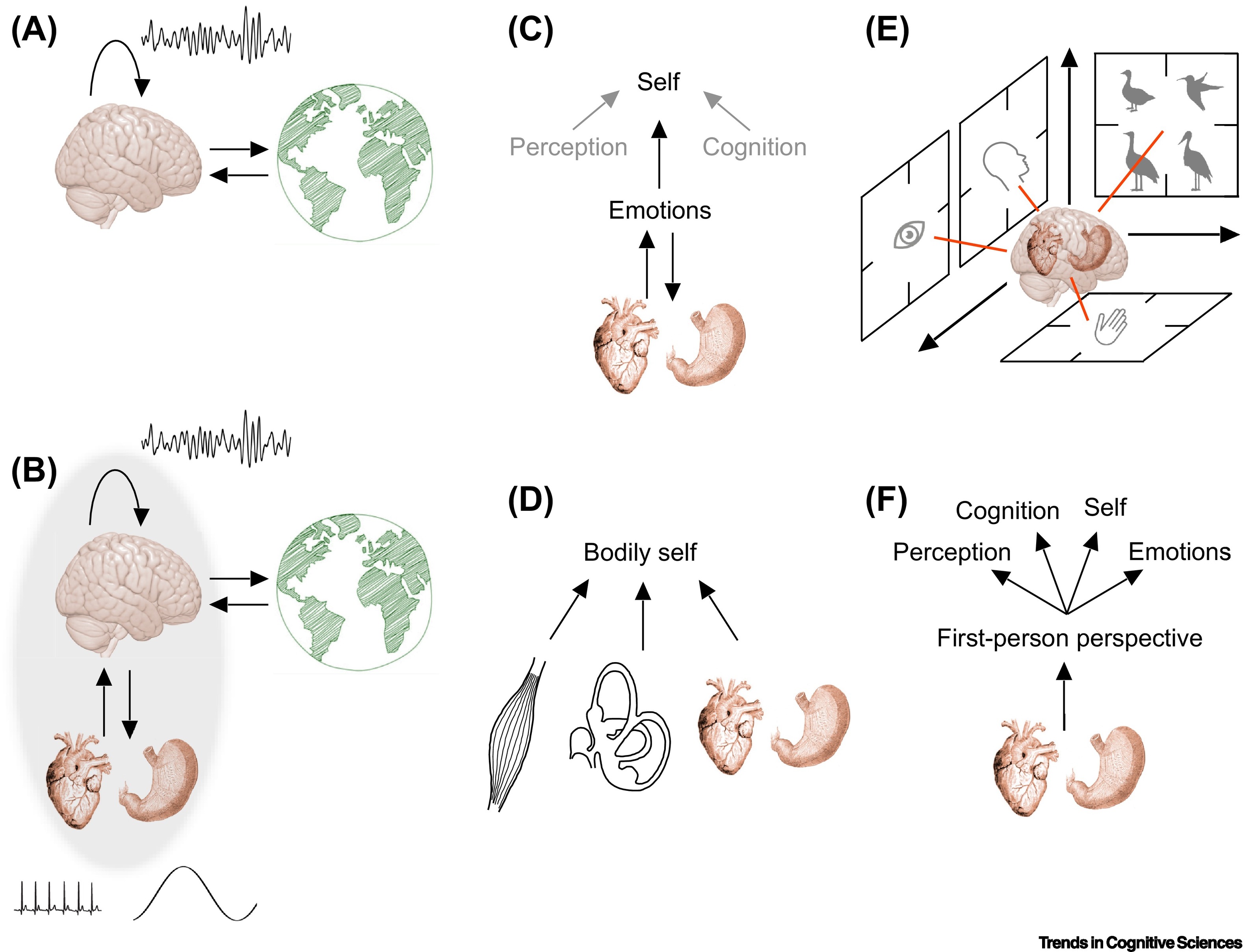
Brain–Viscera Interactions. (A) Classical paradigm of brain–environment interactions. (B) Extended paradigm that includes brain–viscera interactions, and more specifically the heart and gastrointestinal tract, which both intrinsically generate their own electrical activity and potentially contribute to brain dynamics by continuously and automatically stimulating the brain. (C) According to some theories, changes in visceral states could contribute to emotions and ultimately the self. (D) Another view holds that the bodily self arises from the multisensory integration of proprioceptive, vestibular, and also visceral ascending signals. (E) A third proposal is that neural monitoring of ascending visceral inputs is used to coordinate the different frames of reference in which sensory, motor, and cognitive information is organized, to (F) generate the first-person perspective inherent to conscious perception, cognition, self, and emotions. FULL ARTICLE HERE
Our emotional experiences are linked to changes in our bodily states. For example, the experience of fear results from an integration of an external input (something scary) and an internal physiological state of the body (such as shallow breathing, sweating, increased heartbeat). This integration happens in the brain region called the insula. Subtle shifts in physiological states, even when not perceived consciously, may directly contribute to emotional feelings.
Signals from our body also form the sense of self. Our sense of self is grounded in our sensory experiences: sight, hearing, smell, touch, proprioception (the sense of muscles and tendons), vestibular sense (the sense of balance and spatial orientation) and interoception (the sense of heartbeat, guts, temperature and other body signals). External signals shift and change constantly, and even a slight head move may change the way we see things. Internal bodily signals, even if unnoticed, are more constant. Researchers suggest that continuous neural inputs from the gut and heart to the brain generate the unique bodily-centred viewpoint: the sense of "me", “my body”, “my mental life”. This sense of “mine-ness” is central for our conscious experience.
This latest research changes our understanding of the human mind, consciousness and wellbeing, and shows a paradigm shift in Western science — we see now that the mind and body form a single system and are inseparable. Our heart can really, and not just metaphorically, carry emotions and the sense of self.
I trust that this new understanding will pave the way for more holistic approaches in healthcare — such as yoga and yoga therapy.
Yoga: embodied practice of connection
“In that heart centre, the mind is conceptualised as a lotus flower, closed and upside down. In anjali mudra, we bring the fingers of our two hands together, the base of the palms touching, with the knuckles apart from each other. The palms are not flat against each other but are shaped like the bud of a lotus flower — ready to blossom with the touch of the sunray just as our hearts are ready to open with the teachings and practice.” — AG Mohan and Ganesh Mohan
HI, I AM IRINA

I am a yoga teacher and a scientist. In this blog I write about the most recent scientific research about yoga/meditation/mindfulness. Please leave comments and share your thoughts!
Feel free to read Irina's previous blogs are here.
You like what you read?
Sign-up for the newsletter and receive updates and more!