

does mindfulness help me to be a better parent?
MINDFULNESS SKILLS IN PARENTING
Do mindfulness skills affect how we behave as parents? We know that mindfulness reduces stress and depression. For some, it helps to restore sleep — and a well-rested parent does a much better job than a sleepless one.
Mindfulness also offers tools to regulate emotions. We learn to react less to distress, and calm down faster. Some mindfulness researchers and trainers believe that regulation of emotions is the key for better parenting: “A child doesn’t have a strong enough nervous system to actually have self-control and they need the extended nervous system of the parent to help regulate their nervous system over and over and over again. Thus, the parent is the extended nervous system for the child until the child can self-regulate.”
From the quantitative point of view, we do not yet understand the effects of mindful parenting. There are too few standardized courses on mindful parenting to evaluate their impact on parents and kids.

THE EFFICACY OF being a MINDFUL PARENT
A recent article evaluated 11 randomized controlled trials of mindful parenting, representing 1,340 parents from six countries. The authors could not make any firm conclusions on child behaviors, child–parent relationships or other wellbeing outcomes for the participating families. However, they showed higher parenting mindfulness scores for parents who took up the course, when compared with a control group.
Even without solid statistical proof of its efficiency, the idea of mindful parenting resonates with me.
“It is about recognizing that every moment is a special moment, and an opportunity to drop into open-hearted spaciousness and discernment, no matter what is happening.”
COMMENT AND SHARE YOUR THOUGHTS BELOW
- Do you practice mindfulness with your children?
- Does it work for you – to slow down and notice what is happening with you and your child at the moment, with openness and acceptance, without judgement?
- Check out The Bridge Membership for ALL caregivers (including parents)
HI, I AM IRINA

I am a yoga teacher and a scientist. In this blog I write about the most recent scientific research about yoga/meditation/mindfulness. Please leave comments and share your thoughts!
Feel free to read Irina's previous blogs here.
You like what you read?
Sign-up for the newsletter and receive updates and more!
the effects of yoga on student mental health
Scientific News by Irina are back: after a break of almost a year, I return to my small but beloved project — scientific news for Network Yoga Therapy. I will write about the latest research on yoga, yoga therapy meditation, and other mind–body practices. Every week I scan through 50–100 new articles on these topics, and try to filter out the most interesting and high quality ones.
STUDENT MENTAL HEALTH
So, today we look at student mental health in a Norwegian yoga study. Why students? Young people often experience mental difficulties, but rarely seek help. To prevent them from slipping into depression and other severe conditions, it is essential to find effective preventive interventions that reduce stress and maintain mental health.
Students who did yoga showed significant reductions in stress levels and statistically significant improvements in quality of life and mindfulness. The number of students in the yoga group with high-stress scores decreased by a third. Moreover, the effect was noticeable even three months after the end of the intervention.
The Norwegian study involved 202 university students (87% women). The students were randomly divided into two equal groups. One group did yoga twice a week for three months; the other/control group was on a waiting list. The effect of the exercises was measured three and six months after the start, using standard psychological questionnaires.

Students who did yoga showed significant reductions in stress levels and statistically significant improvements in quality of life and mindfulness.
Yoga study
I like this article because it has a reasonably large sample for a yoga study. The more participants there are in a study, the better you can trust the statistical results. Like in many other psychological studies, the effect of yoga was moderate — which means that yoga did not necessarily help all students in the group. But those who did yoga were more likely to improve their condition.
I also like that the students in the control group were invited to start the same yoga course once the study ended. It's a fair (and a very yogic) way to organise such a study.
HI, I AM IRINA
I am a yoga teacher and a scientist. In this blog I write about the most recent scientific research about yoga/meditation/mindfulness. Please leave comments and share your thoughts!
Feel free to read Irina's previous blogs are here.
Share your thoughts!
I would love to hear back from you — please get back to me with your comments, questions and tips. What topics interest you the most?
You like what you read?
Sign-up for the newsletter and receive updates and more!
self-compassion in a crisis
KINDNESS and compassion KEEPS YOU HEALTHY
Do you know that being kinder to yourself makes you healthier? People who are more compassionate and less judgemental towards themselves have fewer physical health complaints, feel less stressed, and make better lifestyle choices.
WHAT IS A HEALTHY LIFESTYLE EXACTLY?
In a new study, published last week in the Journal of Health Psychology, researchers asked people how often they engage in certain behaviors — for example, stretching exercise, or cooking healthy meals. The full test used in the research included 52 questions, and measured lifestyle in six domains: health responsibility, physical activity, nutrition, spiritual growth, interpersonal relations, and stress management.
The researchers also measured the level of self-compassion in the same sample (over 300 people). They found a strong association between self-compassion and healthy lifestyle choices. The association was strong in both men and women across all ages. Self-compassion includes three main components:
- self-kindness
- mindfulness
- a sense of shared humanity
BE KINDER. START NOW.
Self-kindness means being warm and caring towards yourself during challenging times in your life. Among all components of self-compassion, self-kindness seems to have the highest association with a healthy lifestyle. The study shows that people who are kinder to themselves are more likely to eat healthy. They also feel more responsible for their health. Several earlier studies showed that kindness may also help us to adjust to changing circumstances.
NOTICE HOW YOU FEEL
Mindfulness refers to the ability to open up to any experience with a non-reactive and balanced awareness. It means accepting that certain situations and feelings are difficult or painful. A non-judgemental and accepting stance helps regulate your behavior and handle difficult situations, and puts you in a better place to make important decisions.

SAME VIRUSES AFFECT ALL OF US
Finally, shared humanity represents the perception that other people experience the same difficulties, rather than seeing one’s troubles as isolating and misunderstood by all others. The present coronavirus crisis makes the idea of shared humanity especially clear: we are all in it together. Just think about it: for the first time in its history, humanity is facing a crisis that affects every one of 7000000000 humans on the planet. We are connected, and you can hear very similar stories of overwhelmed hospitals, suffering businesses, and people struggling in the lockdown from all parts of the world.
THE WORLD NEEDS KINDNESS AND NON-JUDGEMENT
In previous research, self-compassion was found to be related to decreased levels of pain, anger, tension, and emotional pain in individuals with chronic pain. Self-compassion exercises were related to the lower levels of both emotional and physical symptoms of depression. How does it work? Therapists suggest that the practice of self-compassion allows us to:
- Process difficulties, stress and negative emotions in more effective ways
- Take actions that can lead to a more balanced and healthy emotional experience
- See options to change oneself and/or the environment around oneself in a positive way
SELF COMPASSION IN A CRISIS
We live in a time of great uncertainty. We might be worried about our own health and about our loved ones. We might be losing money and be overwhelmed by financial insecurity. We might be struggling from the quarantine rules, unable to travel and reunite with our families. Social media and online offerings, although indispensable these days, may be making it worse. There is so much information and opinions out there. And it feels like we are expected to use this time to create, produce and perfect ourselves (did you check out that list of recommended series for quarantine? Or maybe you have signed up for one of those free online university courses, a new fitness regime or a water painting workshop?). You may find yourself stressed, distracted, and struggling to build a new routine. And we do not know how long this situation will last.
PERHAPS THE BEST THING YOU CAN DO IS TO START WITH SELF-COMPASSION
Here is a short self-compassion mantra that I use often for myself; I first discovered it in the book by Kirsten Neff, the pioneer of self-compassion research.
When I notice something about myself I don’t like, or whenever something goes wrong in my life, I silently repeat the following phrases:
This is the moment of suffering.
Suffering is part of life.
May I be kind to myself in this moment.
May I give myself the compassion I need.
You like what you read?
Sign-up for the newsletter and receive updates and more!
HI, I AM IRINA
I am a yoga teacher and a scientist. In this blog I write about the most recent scientific research about yoga/meditation/mindfulness. Please leave comments and share your thoughts!
Feel free to read Irina's previous blogs are here.
yoga helps to treat infertility
Mind–body interventions in infertility and pregnancy rates
A systematic review published in January 2020 analyzed a dozen studies of mind–body interventions in infertility. The outcomes are compelling: yoga and mindfulness practices reduce anxiety and depression in women during infertility treatment.
There is also an indication that mind–body interventions increase pregnancy rates, though not many studies followed the participants for a sufficiently long time to make reliable conclusions about pregnancy outcomes.
“When faced with a diagnosis or a life crisis, do we turn a deaf ear to all the helpless voices inside us calling out for help, or give each one the attention it deserves? — The Fertile Female by Julia Indichova
Grief, depression, and anxiety
Most women included in the reviewed studies had signs of mild anxiety and depression. It is not surprising — women undergoing infertility treatments have possibly lived through years of despair, guilt, and grief.
Infertility problems and pregnancy losses are prevalent: one in ten pregnancies results in miscarriage. Yet, we do not talk about it openly, and women often receive little support during the time of treatment.
Western protocols offer technical solutions to infertility but do not give us the tools to cope with difficult emotions. Holistic treatments and mind–body practices can fill this gap. I had a first-trimester miscarriage myself and felt incredibly sad and lonely, especially since I had to decide if I wanted to terminate the pregnancy when the heartbeat was no longer detectable. Yoga helped me to find compassion towards my body, rather than feeling angry with its failure. Yoga also helped me to navigate through waves of anxiety during the following pregnancy.

Is there “yoga for hormones”?
Research data now confirms what many other women and myself have discovered before: mind–body practices can support us on the path to motherhood. We do not know if it is particular yoga asanas that are helping, or perhaps it is simply the general de-stress quality of yoga.
If we want to build a balanced practice, it's better to let go of the idea that one asana targets one specific hormone problem.
Physical exercises affect many hormones and body parameters, such as heart output, blood biochemistry, and nutrient supply to organs. Slow breathing and focused attention reduce physiological stress reactions. As a combination of meditation and physical exercise, yoga could be an efficient protective strategy against hormonal imbalances. A shift in the physiological state towards calm and resilience makes miracles happen.
yoga therapy, mental health & mother earth?
terrapy | integrative yoga therapy
HI, I AM IRINA
I am a yoga teacher and a scientist. In this blog I write about the most recent scientific research about yoga/meditation/mindfulness. Please leave comments and share your thoughts!
Feel free to read Irina's previous blogs are here.
what can yoga do for healthcare?
Healthcare professionals under stress
According to a report by the Dutch National Register of occupational disorders, healthcare providers in the Netherlands experience more mental distress than professionals from any other sector. At the same time, British Medical Association talks about a mental health crisis in healthcare professionals. Chronic stress, mood fluctuations and sleep disturbances put doctors at risk for health problems. A survey of thousands of doctors and medical students shows worrying levels of burnout, a high prevalence of psychological and emotional conditions, and a concerning number turning to alcohol, drugs, or medication (British Medical Association 2019).
“While there is no denying that being a doctor is a challenging and demanding role, too often the line of what can be considered routine pressures of the job has most definitely been crossed and the consequence is a workforce that has been pushed to literal breaking point.” – BMA
Good care starts with yourself
At Network Yoga Therapy we believe that yoga-based practices should be included in the healthcare sector, as a lifestyle management tool both for doctors and patients. Yoga is a tool for transforming mind and body patterns and working to improve health and wellbeing. In a world where most diseases come from poor lifestyle choices, yoga can be seen as a “lifestyle therapy”.
A study that came out last week (January 2020) in the Journal of Alternative and Complementary Medicine showed that yoga improves psychological and occupational health in frontline professionals. The study participants took part in a 5-day course, including yoga, meditation, mindfulness, and breathing exercises. A series of psychological tests showed an improvement in stress levels, mindfulness, empowerment, and self-compassion immediately after the course. Practicing yoga brought sustained improvements in the long-run: the study shows that the positive changes lasted for at least 6 months.
In what way can yoga or yoga-based lifestyle interventions be integrated in healthcare? Do you know of any ongoing projects anywhere in the world?
Personal empowerment and holistic lifestyle management
This year we started Svastha 200 hours yoga teacher training and professional development for healthcare professionals, in collaboration with the Amsterdam School for Integrative Medicine & Health. During this training, we work towards personal optimal balance through an intensive yoga and meditation program. We investigate the original holistic wisdom from the yogic tradition and the basic principles of Ayurveda for optimal health balance. We show how to develop yoga and meditation classes for groups and in a 1-on-1 setting, for example in the consultation room.
You like what you read?
Sign-up for the newsletter and receive updates and more!
HI, I AM IRINA
I am a yoga teacher and a scientist. In this blog I write about the most recent scientific research about yoga/meditation/mindfulness. Please leave comments and share your thoughts!
Feel free to read Irina's previous blogs are here.
does meditation change the brain? The chicken-and-egg question
Does meditation change the brain? Or do an individual brain's qualities make some people more attracted to meditation than others?
You might expect someone who meditates regularly to show up as calm and thoughtful. Yes, research shows that meditation practitioners tend to have low impulsivity. But what comes first? Does meditation make someone less impulsive? Or do naturally calm people choose to spend time meditating?
Impulsivity is a personal trait, a tendency to act on a sudden urge. Extreme impulsivity is linked to psychological disorders (ADHD, personality disorders, and even brain injuries). Studies show that impulsive behavior correlates with brain structures responsible for planning and motor control.
A 2019 study compared these brain structures in long-term meditators (people with thousands of hours of lifetime meditation practice) with people who have never meditated. Researchers found differences in the neural measures of impulsivity between the groups. However, the brain measures were not dependent on the extent of meditation practice. Instead, differences between meditators and non-meditators may be pre-existing. People with a particular neurological make-up may be more attracted to extensive meditation practice than others.
REFLECT NOW!
Does meditation change the brain and personality? Or do baseline differences in impulsivity, compassion, and other characteristics make some people more attracted to meditation?

Another study from 2013 showed that people engaging in compassion meditation might have a neurological predisposition in the way they respond to suffering. The study participants received painful electrical stimulation, and watched others receiving same stimulation. Neuroscientists put people through this unpleasant process to measure their empathy and brain responses. Participants then took up compassion and mindfulness meditation training. The brain activity in response to pain predicted how much time they would spend practicing mindfulness and compassion.
Does meditation change the brain and personality? Or do baseline differences in impulsivity, compassion, and other characteristics make some people more attracted to meditation?
I think that, likely, both are true.
Anything that we do over and over again shapes our brain. At the same time, our brain determines if we stick to the practice.
You like what you read?
Sign-up for the newsletter and receive updates and more!
HI, I AM IRINA
I am a yoga teacher and a scientist. In this blog I write about the most recent scientific research about yoga/meditation/mindfulness. Please leave comments and share your thoughts!
Feel free to read Irina's previous blogs are here.
the art of slowing down
This article, written by Ganesh Mohan and A.G. Mohan, appeared in The Hindu newspaper.
Yoga and slowing down
Yoga is the practice of inner stillness. But modern life pushes us to the opposite. One of the main reasons for this is the feeling and habit of being rushed, of hurrying.
Examine the sentences running through our minds in the course of a regular day. We push ourselves with dialogue that make us feel restless and hurried, many times over.
We use phrases like, “ASAP, there’s no time, quickly, hurry up, right now, right away, why is it taking so long…”
The more we say those words to ourselves, the harder it is for any other part of us, to slow down. When we practice yogic mindfulness, we pay attention to what’s happening in the mind, and we realise that our thoughts are often rushed. The mind can’t just rest; it prods us to do more, and in a hurry.
This habit of hurrying is insidious in modern life. It has permeated our daily life, both at work and at home. Digital devices have made it very easy for us to hurry even more, to stay connected all the time.
If we have to wait for a few minutes, we immediately send a message saying, “Where are you? I am here already.” Of course, it’s good to have modern communications, to be in touch, and to get things done. But when hurrying becomes a way of life, it damages our well-being and peace of mind.
Could we change our inner dialogue to slow down instead of hurrying?
If we tell ourselves, “Taking the time as you need.” “Whenever you feel ready.” “If it takes a little longer, that’s okay.” “Patiently…”
We don’t often hear people saying these phrases, isn’t it?
This practice of slowing down is a necessity to reduce stress and practice positive changes for our body and mind. This is one of the reasons why asana and breathing practices in yoga is best done by slowing down. It’s also useful to speed up and exercise. But that is not a substitute for slow movement, slow breathing and patient attention.

cultivate the skill of slowing down and being present
Does it make sense to say, “Be calm. But do it quickly!” Or, “Be mindful. Meditate. But hurry, there’s no time.” It does not make sense. How can we calm down or be mindful when we are rushed?
Hurrying is deeply embedded in us in modern life to the extent that we often don’t listen even when we are given permission to slow down. We don’t believe that we can. We think we will miss out on life. And there’s an impression that if you’re not running around and doing something all the time, there’s something wrong with you. Is this really true?
Life is always experienced in the present. It is not found in a future that we wish to hurry toward. The future doesn’t exist yet, and when it does, it will be the present. One of the key messages of yoga is to watch your mind with appreciative and restful awareness! To do that, we should cultivate the skill of slowing down and being present, at least for a small portion of every day.
Try bringing this practice of slowing down to your asanas. Take a few deliberately slow breaths every hour. You could speak more mindfully and slowly for a few minutes every day. Eat one meal everyday slowly. Small steps. Let slowing down make you calmer, and notice that you can appreciate life better when you take the time to do so. Yoga happens when we take the time to be present with the practices and with our life.
HI, I AM ganesh

I was trained from childhood in yoga and other related traditional studies. I'm a doctor, having trained in both modern medicine and Ayurveda.
You like what you read?
Sign-up for the newsletter and receive updates and more!
Top 5 misleading yoga instructions
We occasionally hear instructions from yoga teachers that set our alarm bells ringing. Some of these instructions are misguided but relatively harmless, but others can have downright detrimental effects.
Check out the facts behind the top 5 misleading instructions below — and next time you hear instructions like these, pause and allow yourself some critical thought. Whether teacher or student, we can all reflect carefully on what information we absorb and repeat.
Instruction 1. Stimulate thyroid in halasana
The thyroid is a small endocrine gland in the neck. There is a belief that flexing the neck in halasana or similar asanas stimulates the thyroid. However, there is no convincing scientific evidence for this idea. No scientific study has compared the endocrine effects of halasana to that of other asanas.
#REFLECT NOW! Why would stimulating the thyroid be a selling point for halasana? Excess of thyroid hormones leads to a range of unpleasant symptoms, including insomnia, anxiety and heart problems. For people who do not suffer from thyroid hormones deficiency, stimulating the thyroid might not be such a good idea. Yoga (as well as other types of physical exercise) affects many hormones and body parameters such as blood pressure and heart rate. A balanced yoga practice could be an efficient protective strategy against metabolic disorders, even if we let go of the idea that one asana targets one specific endocrine gland.
INSTRUCTION 2. TWIST TO DETOX
A perfect example of a commercial myth is ‘detoxifying ’! Toxins don’t build up in the body. Our liver and kidneys are continuously busy excreting metabolic products. If the kidneys or liver fail to do their job, a severe organ dysfunction requiring medical aid develops rather quickly. If the kidneys and liver are functioning well, there is no need to eliminate toxins with special drinks, massages, or yoga asanas.
#REFLECT NOW! Take a moment to reflect on the whole idea of toxins. Telling someone that they have to detox implies that there is something wrong with them — they are poisoned and dirty from the inside. Isn't it unethical to convey a message like this to a student or client?
INSTRUCTION 3. Use Alternate Nostril Breathing to balance the left and right brain hemispheres
There is no direct passage from the left/right nostrils to the left/right brain hemispheres. When you breathe in through your nose, the air enters the trachea and then goes via the bronchi to the lungs. There, the oxygen gets absorbed into the blood and travels to the brain. It does not matter if you have inhaled with the right, left or both nostrils — the blood flow brings oxygen to both brain hemispheres.
#REFLECT NOW! Why do you need to balance the left and right brain? If you have clear vision and hearing on the left and the right, and you can move your limbs on both sides, then your brain hemispheres are working well in coordination already. However, alternate nostril breathing is a demanding task that requires a lot of concentration. Even if it does not "balance the hemispheres", it is still a great exercise to develop attention and breath awareness — so go ahead and practice!
INSTRUCTION 4. Do inversions to increase blood flow to the brain
The brain is protected from an influx of blood that may damage its delicate capillaries and cause a stroke. Despite what you may have heard at a yoga class, the brain cells are not "bathing in fresh blood" when we are upside down. Besides, inversions tend to slow down the heart and lower blood pressure, which means that the amount of blood going into the brain may even reduce in inversions (check out this research proof!).
#REFLECT NOW! Upside down or not, every mental activity that we take on increases oxygen and glucose supply to the brain. For example, the prefrontal brain areas receive more of these supplements when we meditate. If your aim is to increase the blood flow in the brain in a healthy and safe way, try meditation, juggling, playing music or solving math problems!
INSTRUCTION 5. Watch your thoughts — 85% of them are negative
It is common for people to have repetitive thoughts. We worry about the future or replay past events. In some conditions such as depression and anxiety, worry and rumination become excessive and may increase distress and suffering. But repetitive thinking can also be constructive: it brings healing from emotional wounds of the past and enables us to solve problems and plan the future. The statement "85% of our thoughts are negative" appeals to those of us who love exact numbers, along with similar statements such as: "people only use 10% of the brain", and "people have 70,000 thoughts per day".
#REFLECT NOW! Why would a yoga teacher impose these numbers and make students anticipate that huge amount of negative thoughts? The content of our thoughts is very personal and can be different from day to day. The state of mindful awareness means cultivating a non-judgemental state toward all thoughts, without labeling them "good" or "bad".
What yoga instructions do YOU find misleading?
We would love to hear your thoughts. Leave your comment below!
HI, I AM IRINA
I am a yoga teacher and a scientist. In this blog I write about the most recent scientific research about yoga/meditation/mindfulness. Please leave comments and share your thoughts!
Feel free to read Irina's previous blogs are here.
You like what you read?
Sign-up for the newsletter and receive updates and more!
who am I? Latest research shows that mind and body are inseparable
Mind and body connection
Why is our body so important? Research shows that subtle shifts in our physiological bodily states, even when not perceived consciously, may contribute to our emotions and the sense of self.
“When we hear the word ‘heart’ in ancient yoga texts and the Upanishads, it does not refer to the physical organ pumping away inside our chests. Instead, it refers to the space within the centre of the chest, the space where emotions seem to resonate and the centre of our identities seem to reside in our bodies. That’s where we point when we say “I.” — AG Mohan and Ganesh Mohan
According to Western scientific tradition this does not make sense. But, as we keep learning and pushing the boundaries of physiology and neuroscience, we see the meaning of these ancient texts differently. A recent article in the prestigious journal “Trends in Cognitive Sciences” shows that our cognition is formed by the interplay between the brain and the bodily senses.
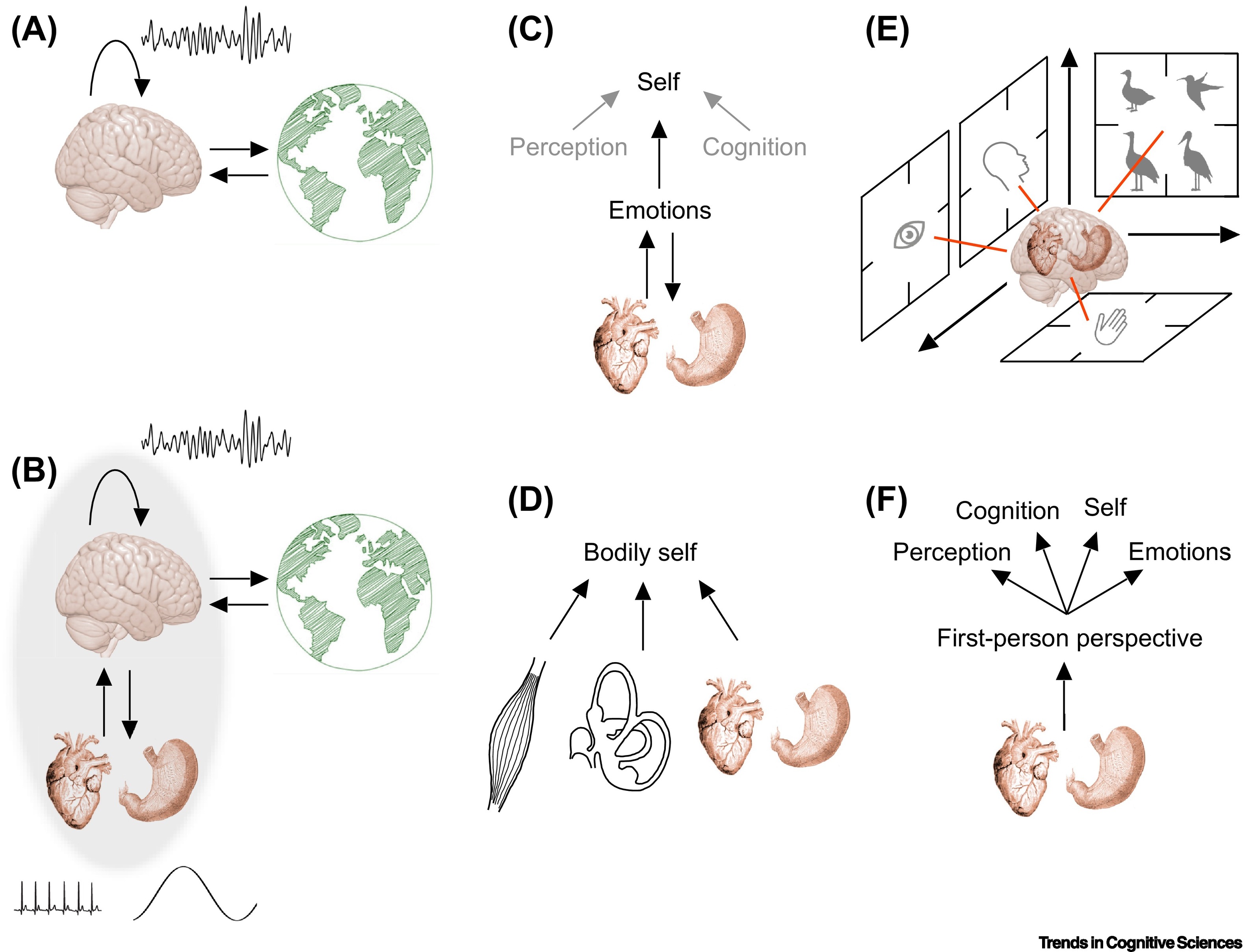
Brain–Viscera Interactions. (A) Classical paradigm of brain–environment interactions. (B) Extended paradigm that includes brain–viscera interactions, and more specifically the heart and gastrointestinal tract, which both intrinsically generate their own electrical activity and potentially contribute to brain dynamics by continuously and automatically stimulating the brain. (C) According to some theories, changes in visceral states could contribute to emotions and ultimately the self. (D) Another view holds that the bodily self arises from the multisensory integration of proprioceptive, vestibular, and also visceral ascending signals. (E) A third proposal is that neural monitoring of ascending visceral inputs is used to coordinate the different frames of reference in which sensory, motor, and cognitive information is organized, to (F) generate the first-person perspective inherent to conscious perception, cognition, self, and emotions. FULL ARTICLE HERE
Our emotional experiences are linked to changes in our bodily states. For example, the experience of fear results from an integration of an external input (something scary) and an internal physiological state of the body (such as shallow breathing, sweating, increased heartbeat). This integration happens in the brain region called the insula. Subtle shifts in physiological states, even when not perceived consciously, may directly contribute to emotional feelings.
Signals from our body also form the sense of self. Our sense of self is grounded in our sensory experiences: sight, hearing, smell, touch, proprioception (the sense of muscles and tendons), vestibular sense (the sense of balance and spatial orientation) and interoception (the sense of heartbeat, guts, temperature and other body signals). External signals shift and change constantly, and even a slight head move may change the way we see things. Internal bodily signals, even if unnoticed, are more constant. Researchers suggest that continuous neural inputs from the gut and heart to the brain generate the unique bodily-centred viewpoint: the sense of "me", “my body”, “my mental life”. This sense of “mine-ness” is central for our conscious experience.
This latest research changes our understanding of the human mind, consciousness and wellbeing, and shows a paradigm shift in Western science — we see now that the mind and body form a single system and are inseparable. Our heart can really, and not just metaphorically, carry emotions and the sense of self.
I trust that this new understanding will pave the way for more holistic approaches in healthcare — such as yoga and yoga therapy.
Yoga: embodied practice of connection
“In that heart centre, the mind is conceptualised as a lotus flower, closed and upside down. In anjali mudra, we bring the fingers of our two hands together, the base of the palms touching, with the knuckles apart from each other. The palms are not flat against each other but are shaped like the bud of a lotus flower — ready to blossom with the touch of the sunray just as our hearts are ready to open with the teachings and practice.” — AG Mohan and Ganesh Mohan
HI, I AM IRINA
I am a yoga teacher and a scientist. In this blog I write about the most recent scientific research about yoga/meditation/mindfulness. Please leave comments and share your thoughts!
Feel free to read Irina's previous blogs are here.
You like what you read?
Sign-up for the newsletter and receive updates and more!